

How to Stop Plaque is easier when you understand how plaque forms and what you can do daily to prevent it from damaging your teeth and gums. Every single day, a silent countdown resets inside your mouth, as an invisible layer of bacteria begins forming on your teeth.
Right now, an invisible, sticky film of bacteria is forming over your teeth. It’s called plaque. In its initial stage, it is soft, vulnerable, and incredibly easy to get rid of. But if you leave it alone for just 48 hours, something drastic happens.
That soft film absorbs the natural minerals in your saliva and undergoes a chemical transformation. It calcifies. It hardens. It literally turns to stone.
Once that happens, you are no longer dealing with plaque. You are dealing with tartar (also known as dental calculus), and your toothbrush can no longer save you.
Here is exactly what happens during that critical 48-hour window, and the #1 way to stop the clock before it’s too late.
The 48-Hour Countdown: From Soft Film to Solid Rock
To defeat the buildup, you have to understand the enemy’s timeline.
- Hour 0 to 4 (The Arrival): Within hours of brushing, a microscopic layer of proteins from your saliva forms on your teeth. Bacteria quickly move in, feeding on the leftover sugars and carbohydrates from your meals.
- Hour 4 to 24 (The Biofilm): The bacteria multiply, creating a organized colony. This is the fuzzy, sticky coating you feel on your teeth when you wake up or at the end of a long day. It is still soft enough to be wiped away with basic friction.
- Hour 24 to 48 (The Calcification Zone): This is the danger zone. If the plaque isn’t physically disrupted, it begins mixing with calcium and phosphate in your saliva. The mineral crystals bond with the bacteria, cementing them to your enamel.
- Past 48 Hours (The Stone Age): The transformation is complete. The soft plaque is now a hard, yellow or brown crust.
Why Tartar is Bad News for Your Smile
Allowing plaque to cross the 48-hour finish line does more than just make your teeth feel rough. Tartar creates a porous, gritty surface that acts like a magnet for even more plaque. Once plaque becomes tartar, brushing and flossing alone usually cannot remove it. It’s a vicious cycle that quickly leads to:
- Chronic Bad Breath (Halitosis): Hardened bacteria traps foul-smelling compounds.
- Gingivitis: The bacteria irritate and inflame your gums, causing them to bleed when you brush.
- Periodontitis: Left unchecked, tartar creeps beneath the gumline, destroying the bone and tissue that support your teeth.
The Best Way to Stop Plaque Before It Hardens
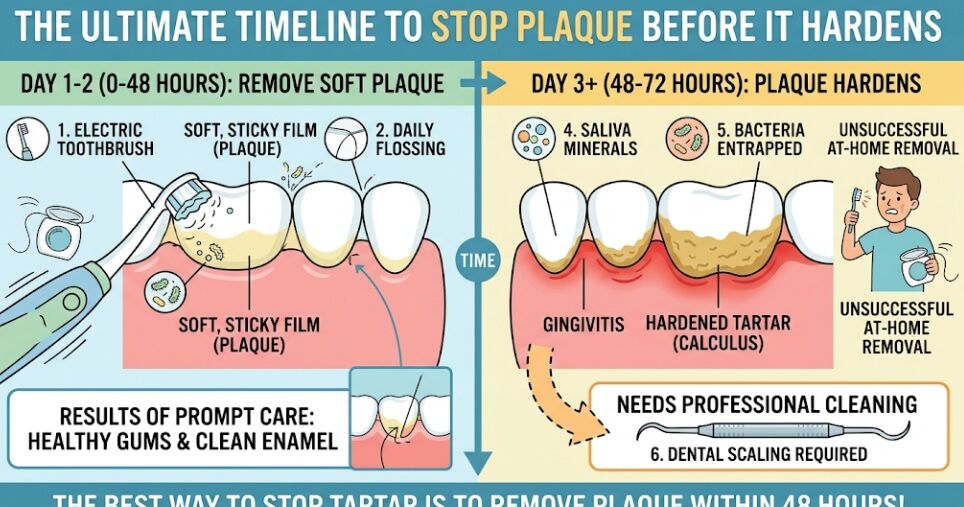
You don’t need extreme hacks or complicated treatments. Plaque control comes down to consistent, mechanical cleaning.
1. Brush Effectively
A quality electric toothbrush can help improve plaque removal, especially if you struggle with manual brushing technique. However, the most important factors are consistency, proper technique, and reaching all tooth surfaces.
2. Don’t Ignore Between Your Teeth
Your toothbrush cannot fully clean the tight spaces between teeth. Flossing or using interdental cleaners helps remove plaque from these hidden areas before it can cross that 48-hour threshold.
Areas Where Tartar Often Builds Up
Some spots in your mouth are naturally prone to faster mineral buildup because they sit right next to major salivary gland openings. Pay extra attention to these two high-risk zones when brushing:
- The inside surfaces of your lower front teeth: These sit directly next to the salivary glands under your tongue, making them the most common spot for tartar to pool.
- The outside surfaces of your upper back teeth: These face the salivary glands inside your cheeks, meaning plaque here calcifies much quicker than in other areas.
What If You Already Have Tartar?
Important Safety Note: Do not try to scrape tartar off yourself using sharp DIY tools or at-home dental picks. Attempting this can severely injure your delicate gum tissue or permanently scratch your tooth enamel.
Once plaque has calcified, a dental professional must remove it safely using specialized ultrasonic and manual scaling tools.
The Simple Rule
Plaque is easy to fight when it is soft. Your best defense is not a miracle product, it is a daily habit:
- Brush thoroughly at least twice a day.
- Clean between your teeth daily.
- Don’t let plaque sit long enough to harden.
Your future smile depends on what you do today.
The Final Countdown
At the end of the day, your mouth is a battleground where consistency beats intensity every single time. You don’t need a perfect diet or a counter full of expensive dental gadgets to protect your smile, you just need to beat the clock.
That 48-hour window is constantly resetting. Every single time you pick up your toothbrush or run a strand of floss between your teeth, you win the battle against plaque. Commit to those four minutes a day, keep the momentum going, and give your dentist nothing to scrape away at your next checkup.
Learn More:
For more information about preventing tooth decay, plaque control, brushing, flossing, and maintaining good oral health, visit the American Dental Association (ADA)
Want More Healthy Living Tips?
Health is built through small daily choices. Stay informed with more easy-to-understand health tips, wellness guides, and helpful information you can share with your family.
👉 Follow our page: Daily Health Express for more health updates, lifestyle tips, and wellness content you can trust and share with your family. 🌿